
Essential Care
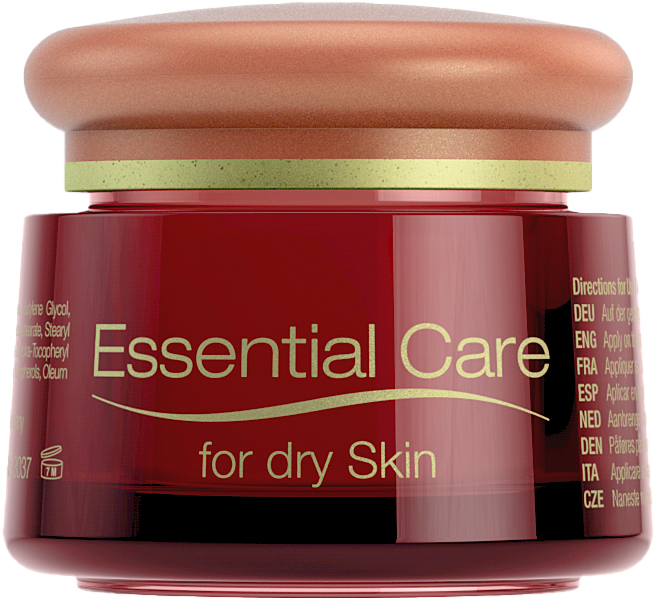
Essential Care
Essential care for dry skin.
30 ml Jar
Art.-No. 3037
Aqua, Prunus Armeniaca Kernel Oil, Simmondsia Chinensis Oil, Butylene Glycol, Urea, Polyglyceryl-3 Methylglucose Distearate, Stearyl Alcohol, Palmitic Acid (and) Stearic Acid, Sodium Lactate, Methyl Glucose Sesquistearate, D-alpha-Tocopheryl Acetate, D-Mixed Tocopherols, Lactic Acid, Allantoin, Citrus Limon Peel Oil, Vanillin, Xanthan Gum, Citral, Limonene
Aqua:
Water. It makes up approximately 65% of the weight of the human body and is therefore essential for bodily functions, including those of the skin. In many cosmetic products (aqueous solutions, cleansers, emulsions), water is the ingredient with the largest proportion of the formulation and forms the basis of the aqueous phase in emulsions. Water is a good solvent for polar (hydrophilic) substances such as alcohols, water-soluble vitamins, or salts. For use in cosmetic products, the water used is generally pre-treated to remove microorganisms that could lead to product spoilage or dissolved salts that might impair the stability of emulsions or gels (sterilization and desalination).
Prunus Armeniaca Kernel Oil:
Apricot kernel oil, rich in monounsaturated and polyunsaturated fatty acids
Simmondsia Chinensis Oil:
Jojoba oil: A natural, liquid wax with excellent tolerability and outstanding protective and skin-nourishing properties. Creates a pleasant and velvety skin feel.
Butylene Glycol:
Solvent with moisturizing properties for the skin, very well tolerated, should be preferred to propylene glycol in products used daily.
Urea:
Water-soluble urea is used in numerous cosmetic products. Urea is a component of the natural moisturizing factors in the stratum corneum (content between 7% and 12%; up to half that in chronically dry skin) and has a high water-binding capacity. It contributes to sustained skin hydration and reduces transepidermal water loss. Urea has a keratoplastic effect, and at higher concentrations, a keratolytic effect, and is therefore also used in the care of skin affected by psoriasis or atopic dermatitis (eczema). Furthermore, urea is able to reduce the irritating potential of surfactants.
Polyglyceryl-3 Methylglucose Distearate:
Emulsifier for oil-in-water systems with very good skin compatibility. Derived from glycerin, sugar, and fatty acids.
Stearyl Alcohol:
A fatty alcohol identical to those found in the body, occurring as an intermediate in fat metabolism, also present in small amounts in the epidermis. A consistency enhancer in emulsions.
Palmitic Acid (and) Stearic Acid:
A mixture of palmitic and stearic acid. Skin-identical lipids; skin-conditioning and consistency-regulating in cosmetic products.
Sodium Lactate:
Sodium lactic acid: Has a moisturizing effect on the skin, with the physiological pH value of the skin of an average of 5.5. Important component of the skin's natural moisturizing factor (NMF) and acid mantle.
Methyl Glucose Sesquistearate:
O/W emulsifier derived from glucose and fat, very skin-friendly and moisturizing.
D-alpha-Tocopheryl Acetate:
Natural vitamin E acetate; storage form in the skin, converted into the active form by breaking the acetate bond; antioxidant with skin-protecting properties, e.g., against UV radiation, moisturizing, delays premature skin aging
D-Mixed Tocopherols:
This is the name given to a mixture of natural tocopherols (vitamin E; D-alpha, beta, gamma and delta tocopherol). Vitamin E is the most important skin-protecting vitamin, shielding the skin from UV rays and free radicals.
Lactic Acid:
Lactic acid. Occurs as a metabolic product in the body and on the skin; in higher concentrations and at a low pH value of 2 to 3, it has an exfoliating effect on the stratum corneum; in buffered form (physiological pH value of the skin approx. 5.5), it supports the moisture content and preserves the skin's acid mantle.
Allantoin:
Allantoin is a naturally occurring, water-soluble substance chemically related to urea. It is found in various plants, but for cosmetic use, it is now produced synthetically. Its most important property is the stimulation of cell regeneration. It promotes collagen production, skin regeneration and wound healing, stimulates desquamation, smooths the skin, and can have a soothing effect on atopic dermatitis.
Citrus Limon Peel Oil:
Essential oil from lemon peels. Has a refreshing and invigorating effect.
Vanillin:
Natural flavoring agent, antioxidant
Xanthan Gum:
Polysaccharide, a natural gelling agent with very good skin-friendly properties, is obtained biotechnologically.
Citral:
Fragrance, a natural component of essential oils.
Limonene:
Fragrance, a natural component of essential oils.
